
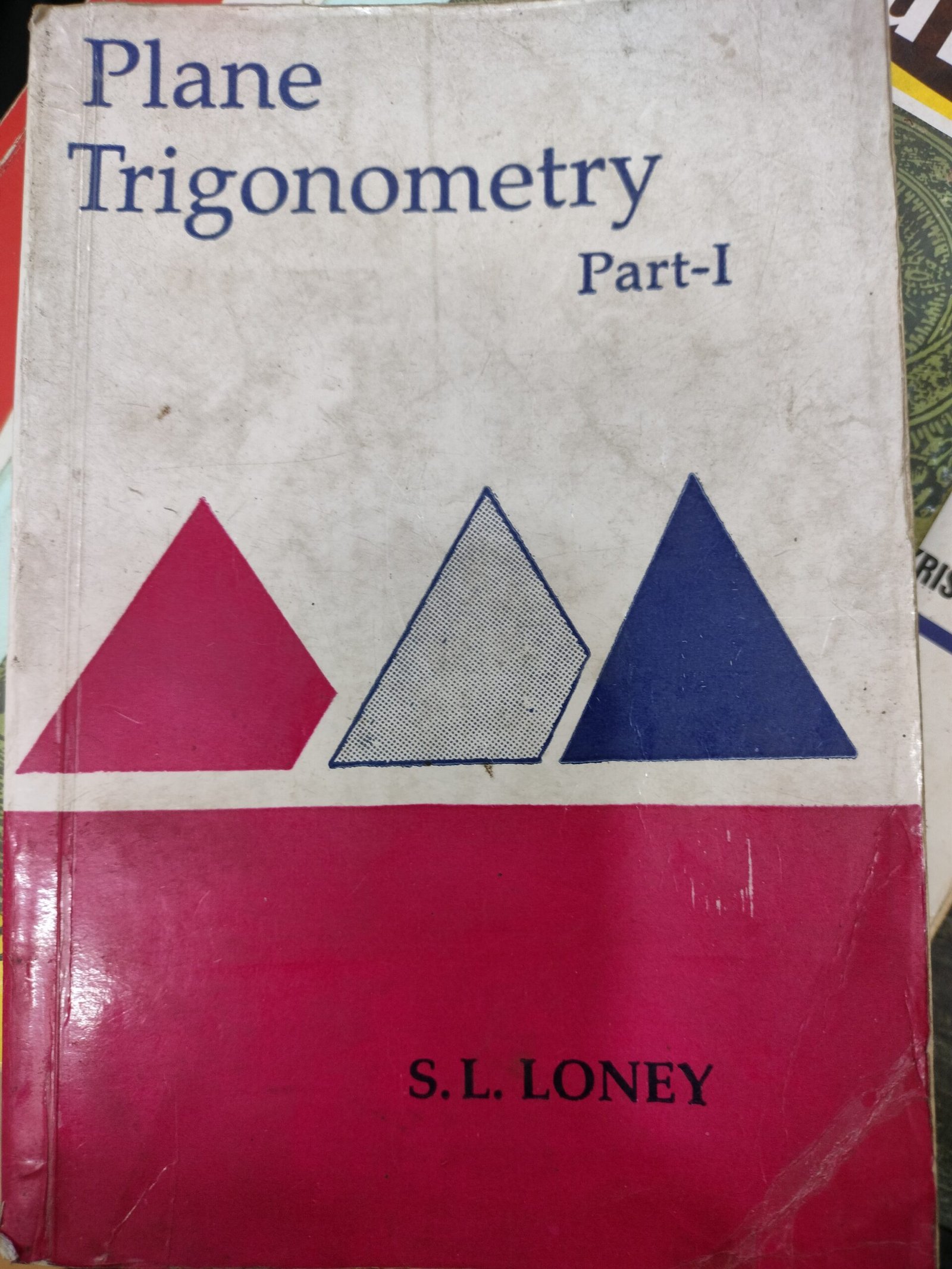
Author: S. L. Loney
Plane Trigonometry Part‑1 by S. L. Loney is a classic trigonometry text that has stood the test of time and remains widely used by students preparing for advanced mathematics or engineering entrance exams. Loney begins with the fundamentals — the measurement of angles in sexagesimal, centesimal and circular (radian) measures — and gradually builds up to more complex concepts with clarity and precision. The book covers trigonometric ratios for acute angles and then extends the discussion to angles of any size or sign, thereby giving readers a broad and solid foundation. It delves into the sum‑and‑difference formulas, multiple and sub‑multiple angle formulas, as well as trigonometric identities and equations, guiding the learner through both theory and application. The treatment of logarithms, tables of sines and cosines, and proportional parts shows that the book blends classical techniques with problem‑solving flair. Geometrical applications such as relation between sides and angles of triangles, solutions of triangles, heights and distances, and properties of triangles and regular polygons are also included, making the text rich in illustrations of how trigonometry meets geometry. What sets it apart is the abundance of examples and the rigorous practice exercises that follow each chapter; these encourage the learner not only to absorb definitions but to apply them. Although first published over a century ago, the book has been updated in modern editions (for instance in the “Classic Text” series) to include current syllabus relevance, making it suitable even for today’s competitive‑exam aspirants. While the notation can feel old‑school and the style formal, the logical progression of topics means that a dedicated student can gain very deep insights from it. In short, Plane Trigonometry Part‑1 is much more than a reference text — it is a structured journey through trigonometry that builds both conceptual understanding and problem‑solving skill.